Katalyze AI Appoints Chief AI Officer to Advance Agentic AI Capabilities in Pharmaceutical Manufacturing
Katalyze AI appoints Dr. Hannes Bretschneider as Chief AI Officer to expand Agentic AI capabilities, strengthening the company’s scientific foundation and accelerating the development of autonomous AI agents built for complex, regulated biomanufacturing environments.
By
Katalyze AI
3
min read
In this News
3
3
min read
Toronto, ON December 2, 2025 — Katalyze AI today announced the appointment of Hannes Bretschneider as Chief AI Officer. Hannes will lead the development of Agentic AI architecture and expand the company’s capabilities across autonomous agents designed for life science manufacturing.
Hannes brings more than a decade of experience in machine learning, genomics, and at-scale computational systems. His background in RNA biology, alternative splicing, microexon detection, and protein interactions directly supports Katalyze AI’s strategy to build agents that can analyze complex scientific data, learn from it, and enable real-time decision making in pharmaceutical manufacturing.
As a co-founder of Deep Genomics, one of the AI pioneers in biotechnology, he led the development of the core scientific computing platform, GenomeKit, for genomic analysis and developed deep learning models for splicing prediction and clinical variant interpretation.
At the University of Toronto, Hannes developed a machine learning tool to detect microexons in genetic sequences and led an industry collaboration that applied machine learning to the discovery of splicing modulators. At Fable Therapeutics, he focused on AI models for antibody design, structure prediction, and protein interactions.
Hannes holds a PhD in Computer Science from the University of Toronto, where he developed some of the very first genomic language models to advance fundamental research in RNA biology, splicing prediction and variant effect classification. His research has been published in Science, Bioinformatics and ISMB.
Hannes brings more than a decade of experience in machine learning, genomics, and at-scale computational systems. His background in RNA biology, alternative splicing, microexon detection, and protein interactions directly supports Katalyze AI’s strategy to build agents that can analyze complex scientific data, learn from it, and enable real-time decision making in pharmaceutical manufacturing.
As a co-founder of Deep Genomics, one of the AI pioneers in biotechnology, he led the development of the core scientific computing platform, GenomeKit, for genomic analysis and developed deep learning models for splicing prediction and clinical variant interpretation.
At the University of Toronto, Hannes developed a machine learning tool to detect microexons in genetic sequences and led an industry collaboration that applied machine learning to the discovery of splicing modulators. At Fable Therapeutics, he focused on AI models for antibody design, structure prediction, and protein interactions.
Hannes holds a PhD in Computer Science from the University of Toronto, where he developed some of the very first genomic language models to advance fundamental research in RNA biology, splicing prediction and variant effect classification. His research has been published in Science, Bioinformatics and ISMB.
Hannes brings more than a decade of experience in machine learning, genomics, and at-scale computational systems. His background in RNA biology, alternative splicing, microexon detection, and protein interactions directly supports Katalyze AI’s strategy to build agents that can analyze complex scientific data, learn from it, and enable real-time decision making in pharmaceutical manufacturing.
As a co-founder of Deep Genomics, one of the AI pioneers in biotechnology, he led the development of the core scientific computing platform, GenomeKit, for genomic analysis and developed deep learning models for splicing prediction and clinical variant interpretation.
At the University of Toronto, Hannes developed a machine learning tool to detect microexons in genetic sequences and led an industry collaboration that applied machine learning to the discovery of splicing modulators. At Fable Therapeutics, he focused on AI models for antibody design, structure prediction, and protein interactions.
Hannes holds a PhD in Computer Science from the University of Toronto, where he developed some of the very first genomic language models to advance fundamental research in RNA biology, splicing prediction and variant effect classification. His research has been published in Science, Bioinformatics and ISMB.
Hannes brings more than a decade of experience in machine learning, genomics, and at-scale computational systems. His background in RNA biology, alternative splicing, microexon detection, and protein interactions directly supports Katalyze AI’s strategy to build agents that can analyze complex scientific data, learn from it, and enable real-time decision making in pharmaceutical manufacturing.
As a co-founder of Deep Genomics, one of the AI pioneers in biotechnology, he led the development of the core scientific computing platform, GenomeKit, for genomic analysis and developed deep learning models for splicing prediction and clinical variant interpretation.
At the University of Toronto, Hannes developed a machine learning tool to detect microexons in genetic sequences and led an industry collaboration that applied machine learning to the discovery of splicing modulators. At Fable Therapeutics, he focused on AI models for antibody design, structure prediction, and protein interactions.
Hannes holds a PhD in Computer Science from the University of Toronto, where he developed some of the very first genomic language models to advance fundamental research in RNA biology, splicing prediction and variant effect classification. His research has been published in Science, Bioinformatics and ISMB.


Reza Farahani, CEO of Katalyze AI, emphasized how Hannes’ leadership strengthens the company’s scientific and technical foundation: “Hannes brings scientific depth, technical rigor, and a track record of building AI systems that operate in regulated environments. His experience in genomics, deep learning, and biological modeling directly strengthens our position as the company delivering Agentic AI solutions for pharmaceutical manufacturing.”
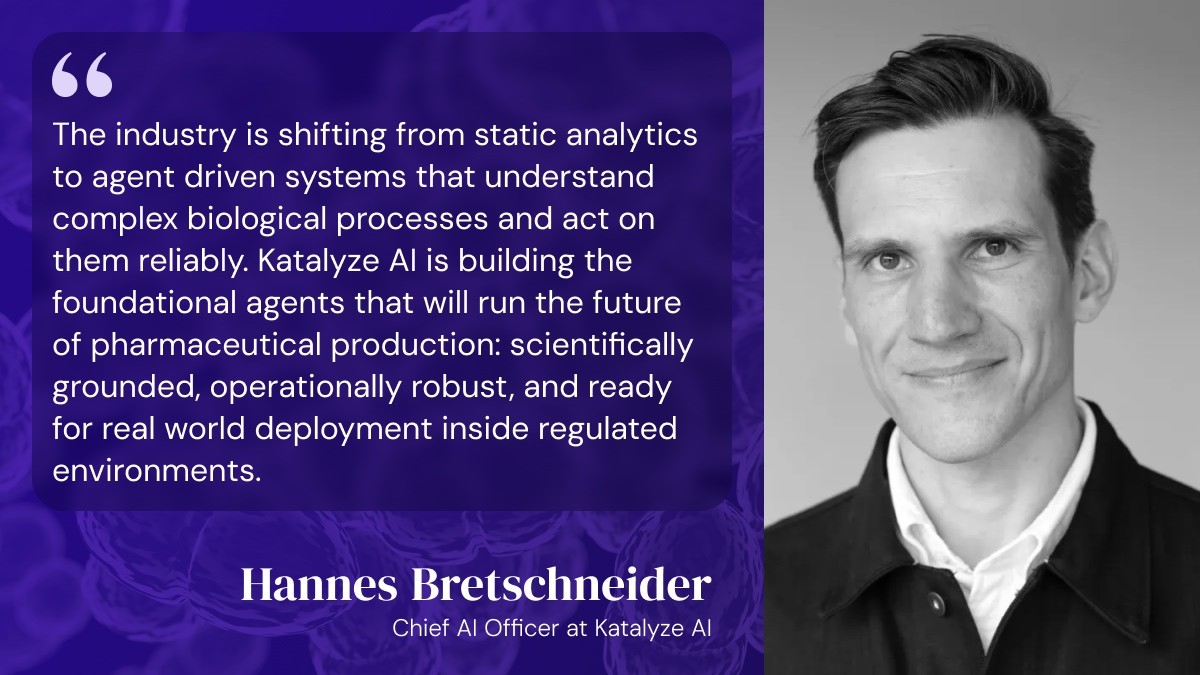
“The industry is shifting from static analytics to agent driven systems that understand complex biological processes and act on them reliably,” said Hannes Bretschneider. “Katalyze AI is building the foundational agents that will run the future of pharmaceutical production: scientifically grounded, operationally robust, and ready for real world deployment inside regulated environments.”
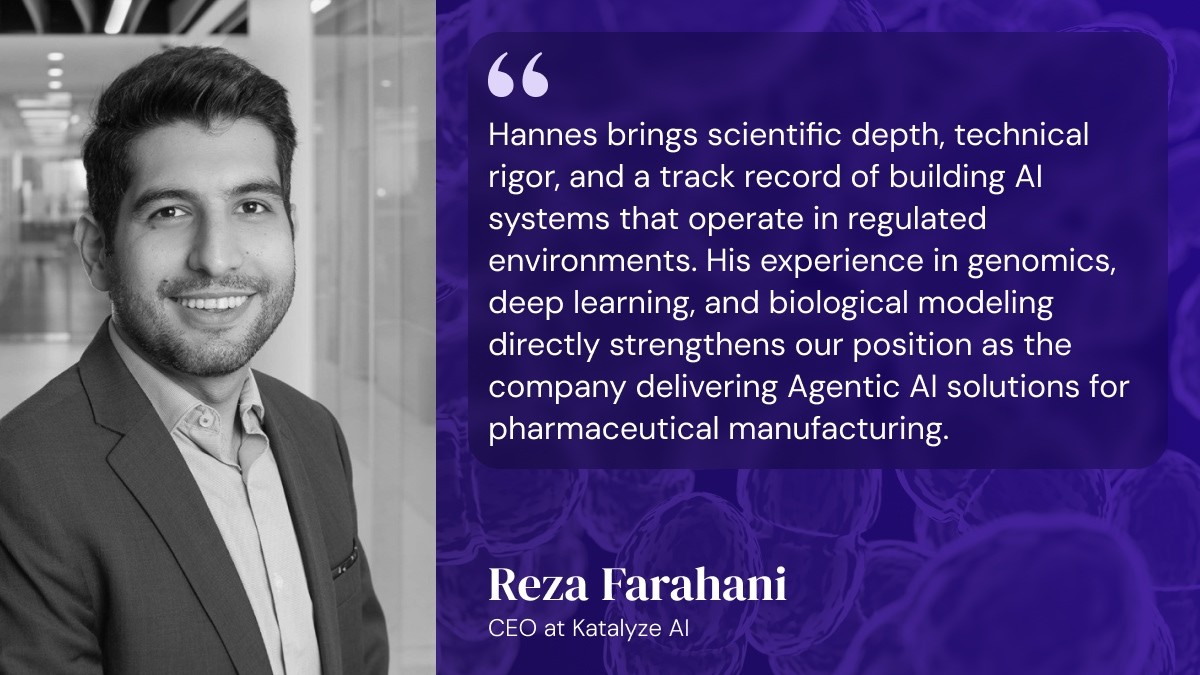
Reza Farahani, CEO of Katalyze AI, emphasized how Hannes’ leadership strengthens the company’s scientific and technical foundation: “Hannes brings scientific depth, technical rigor, and a track record of building AI systems that operate in regulated environments. His experience in genomics, deep learning, and biological modeling directly strengthens our position as the company delivering Agentic AI solutions for pharmaceutical manufacturing.”
“The industry is shifting from static analytics to agent driven systems that understand complex biological processes and act on them reliably,” said Hannes Bretschneider. “Katalyze AI is building the foundational agents that will run the future of pharmaceutical production: scientifically grounded, operationally robust, and ready for real world deployment inside regulated environments.”
Reza Farahani, CEO of Katalyze AI, emphasized how Hannes’ leadership strengthens the company’s scientific and technical foundation: “Hannes brings scientific depth, technical rigor, and a track record of building AI systems that operate in regulated environments. His experience in genomics, deep learning, and biological modeling directly strengthens our position as the company delivering Agentic AI solutions for pharmaceutical manufacturing.”
“The industry is shifting from static analytics to agent driven systems that understand complex biological processes and act on them reliably,” said Hannes Bretschneider. “Katalyze AI is building the foundational agents that will run the future of pharmaceutical production: scientifically grounded, operationally robust, and ready for real world deployment inside regulated environments.”
Reza Farahani, CEO of Katalyze AI, emphasized how Hannes’ leadership strengthens the company’s scientific and technical foundation: “Hannes brings scientific depth, technical rigor, and a track record of building AI systems that operate in regulated environments. His experience in genomics, deep learning, and biological modeling directly strengthens our position as the company delivering Agentic AI solutions for pharmaceutical manufacturing.”
“The industry is shifting from static analytics to agent driven systems that understand complex biological processes and act on them reliably,” said Hannes Bretschneider. “Katalyze AI is building the foundational agents that will run the future of pharmaceutical production: scientifically grounded, operationally robust, and ready for real world deployment inside regulated environments.”


Hannes’ appointment represents a significant expansion of Katalyze AI’s scientific leadership. With his expertise guiding the next phase of development, the company is positioned to accelerate the creation of autonomous agents that enhance manufacturing efficiency, support quality operations, and enable pharmaceutical teams to operate with greater speed, accuracy, and resilience. Katalyze AI plans a phased rollout of new agentic features across core products, combining rigorous validation pathways with user-friendly oversight tools to ensure human-in-the-loop control and regulatory alignment.
About Katalyze AI
Katalyze AI builds Agentic AI systems for pharmaceutical manufacturing. The platform integrates document intelligence, raw material analysis, biological modeling, and autonomous workflows to improve yield, quality, and operational reliability. The company focused on delivering AI agents that operate securely inside regulated environments. The system integrates seamlessly with existing data infrastructure and supports end to end intelligence across laboratory, manufacturing, and quality operations.



Katalyze AI
Katalyze AI
Katalyze AI
Katalyze AI
Katalyze AI builds Agentic AI systems for pharmaceutical manufacturing to integrate document intelligence, raw material analysis and autonomous workflows to improve yield, quality, and operational reliability.
Katalysts Podcast
Subscribe to Gain Insights About AI Solutions
"With Katalyze AI, we can analyze data in real-time and make informed decisions to optimize our processes." Chris Calabretta
Katalysts Podcast
Subscribe to Gain Insights About AI Solutions
"With Katalyze AI, we can analyze data in real-time and make informed decisions to optimize our processes." Chris Calabretta
Katalysts Podcast
Subscribe to Gain Insights About AI Solutions
"With Katalyze AI, we can analyze data in real-time and make informed decisions to optimize our processes." Chris Calabretta
Katalysts Podcast
Subscribe to Gain Insights About AI Solutions
"With Katalyze AI, we can analyze data in real-time and make informed decisions to optimize our processes." Chris Calabretta